kelvin-helmholtz clouds
What is the Kelvin-Helmholtz clouds?
The origin of the name
Kelvin-Helmholtz clouds were named for Scottith physicist Baron Kelvin (1824-1907) and German physicist Hermann von Helmholtz(1821-1994), the two scientists who were the first to describe this pattern of eddies in fluids in the late nineteenth century.
The principle of Kelvin-Helmholtz clouds
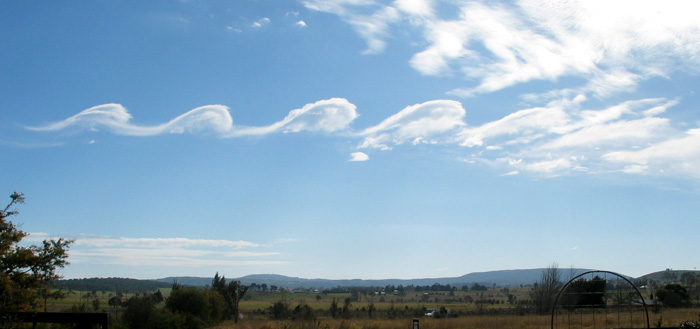
Kelvin-Helmholtz clouds are cirrus clouds that look like breaking ocean waves or narrow, horizontal corkscrew spirals. they are comprised of a series of eddies (small parcel of air that flow in a pattern different from the general airflow). Since they dissipate within a couple of minutes of forming, they are rarely seen.
Kelvin-Helmholtz clouds are the product of a strong wind shear. Wind shear refers to the rate of change of wind speed, or wind direction, over a set distance. the formation of kelvin-helmholtz clouds requires the presence of two vertical air layers of different densities that travel at different speeds. The upper layer must be the warmer and less dense of the two. Given a great enough wind shear, eddies will develop where the two air layers meet.
The origin of the name
Kelvin-Helmholtz clouds were named for Scottith physicist Baron Kelvin (1824-1907) and German physicist Hermann von Helmholtz(1821-1994), the two scientists who were the first to describe this pattern of eddies in fluids in the late nineteenth century.
The principle of Kelvin-Helmholtz clouds
Kelvin-Helmholtz clouds are cirrus clouds that look like breaking ocean waves or narrow, horizontal corkscrew spirals. they are comprised of a series of eddies (small parcel of air that flow in a pattern different from the general airflow). Since they dissipate within a couple of minutes of forming, they are rarely seen.
Kelvin-Helmholtz clouds are the product of a strong wind shear. Wind shear refers to the rate of change of wind speed, or wind direction, over a set distance. the formation of kelvin-helmholtz clouds requires the presence of two vertical air layers of different densities that travel at different speeds. The upper layer must be the warmer and less dense of the two. Given a great enough wind shear, eddies will develop where the two air layers meet.
